

What Data Should Farmers Actually Monitor?
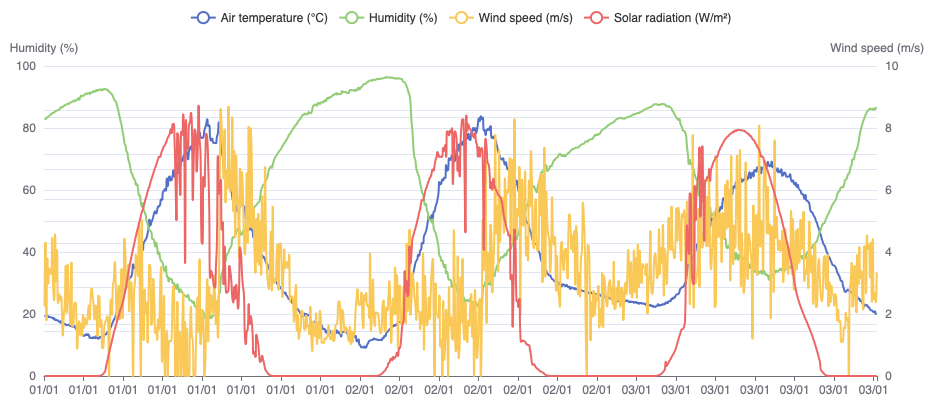
Weather Data From Our Test Site at Cranbrook, WA
As agriculture gets more data-driven, growers face an ever-growing list of sensors and monitoring options. Weather stations, soil probes, flow meters and environmental sensors all promise better decisions, but not all data earns its keep. The real challenge isn't collecting more information, it's working out which data genuinely improves outcomes. Many farms start with a single sensor and expand once they see the value in real-time insight, which is really the right order to do it in: start with the decisions that matter, then work backwards to what data those decisions actually need.
Key takeaways
Start from the decisions you actually need to make, not from the sensors available to buy.
Weather and soil moisture data together cover most of what drives day-to-day farm decisions.
A basic weather station plus one soil probe is a genuinely solid starting point for most farms.
More data isn't automatically better: unused data just adds noise, not insight.
Start with the decisions, not the sensors
Every farm makes a stream of daily and seasonal calls that shape productivity and cost, most of them circling back to water use, crop health, timing and risk. Irrigation scheduling is a classic example: too much water raises costs and can damage the crop, too little cuts yield, and without solid data these calls tend to fall back on experience or assumption. Spray decisions depend on wind speed and direction, frost protection depends on catching a temperature drop in time, and each of these gets sharper with the right data behind it. Working backwards from these core decisions makes it much clearer which measurements are actually worth the investment.
Weather data: the foundation everything else builds on
Weather data is usually where monitoring starts, giving a broad read on conditions that touches almost every farm activity. Rainfall matters most: knowing how much fell, and when, shapes irrigation planning and water management, and even small differences can meaningfully shift soil moisture and crop condition. Temperature and humidity reveal plant stress, disease risk and evapotranspiration, while wind speed and direction are essential for spray decisions, both for compliance and for getting the chemical where it's meant to go. Solar radiation gets overlooked more often than it should, but it's a real input for plant growth and more advanced irrigation modelling. Together, these variables form the base layer that makes every other measurement easier to interpret.
Soil moisture: what's actually happening below ground
Weather data gives context, but soil moisture shows what's really happening in the root zone, how much water is available to the plant and how that changes over time, which is central to genuinely effective irrigation. Without it, irrigation defaults to estimates or a fixed schedule; with direct measurement, water gets applied more precisely, cutting waste and improving consistency. Multi-depth readings add another layer, showing how water actually moves through the profile, whether irrigation is reaching the depth intended, and whether it's draining past the root zone entirely. For a lot of farms, soil moisture ends up being the single most valuable data source they collect.
Watching the irrigation system itself
Beyond environmental conditions, monitoring the irrigation system's own performance pays real dividends. Flow meters and pressure sensors confirm water is being delivered as expected and can catch blockages, leaks or equipment failures well before they'd otherwise be noticed. Water level sensors in tanks or reservoirs give visibility into available supply, supporting better planning and reducing the risk of running dry at a critical moment. Combined with soil moisture data, this builds a genuinely complete picture of how water moves from source to root zone.
What changes by crop
Monitoring needs shift with the crop. Broadacre farming usually centres on rainfall and soil moisture as the primary variables, while more intensive systems like horticulture or vineyards often need additional data to manage quality and consistency. Frost monitoring matters most for temperature-sensitive crops, where early detection allows timely intervention and can prevent serious losses, and some operations add sensors for leaf wetness or canopy temperature for a sharper read on crop health. The goal throughout is matching what's measured to what the crop and the decisions actually require.
Starting small and building out
Not every farm needs a complex system from day one. A basic setup, a weather station and a soil moisture probe, gives a genuinely strong foundation for improving irrigation and understanding conditions, and additional sensors can be added once the value of the data becomes clear, whether that's more soil probes, water monitoring or extra weather stations across different parts of the property. Building gradually keeps the system matched to actual need rather than adding complexity for its own sake.
Why integration matters more than any single sensor
The real value shows up when data sources work together rather than sitting as standalone devices. Weather, soil moisture and irrigation measurements are each one piece of a larger picture, and combined on a single platform, they support deeper insight and sharper decisions than any one data stream alone. Systems built around standard communication protocols and flexible integration make this kind of comprehensive setup far easier to build and expand.
Avoiding data for data's sake
With so many sensors on the market, it's easy to end up collecting more than is actually useful. Too much information gets overwhelming fast, particularly when it isn't clearly tied to a decision, and monitoring everything is rarely the goal, monitoring what matters is. A small number of high-value variables usually beats a large volume of low-impact data, and additional measurements can be layered in later as familiarity with the system grows and clear gaps emerge.
Turning data into something you actually act on
Data only earns its value once it changes a decision. A good system makes information easy to interpret and act on, whether that's setting alert thresholds, spotting trends over time, or folding data into existing workflows: soil moisture triggering irrigation, weather data shaping a spray schedule, alerts flagging when conditions shift. The tighter the link between a piece of data and a specific action, the more that data is actually worth.
The bottom line
Deciding what to monitor ultimately comes down to understanding what actually drives performance on a farm. Focusing on weather, soil moisture and water use gives growers the insight to move past assumptions and respond to real conditions with confidence. A well-designed system doesn't drown a grower in information, it delivers clarity exactly where it's needed, and picking the right data to track remains one of the most important steps in getting real value from a monitoring investment.